

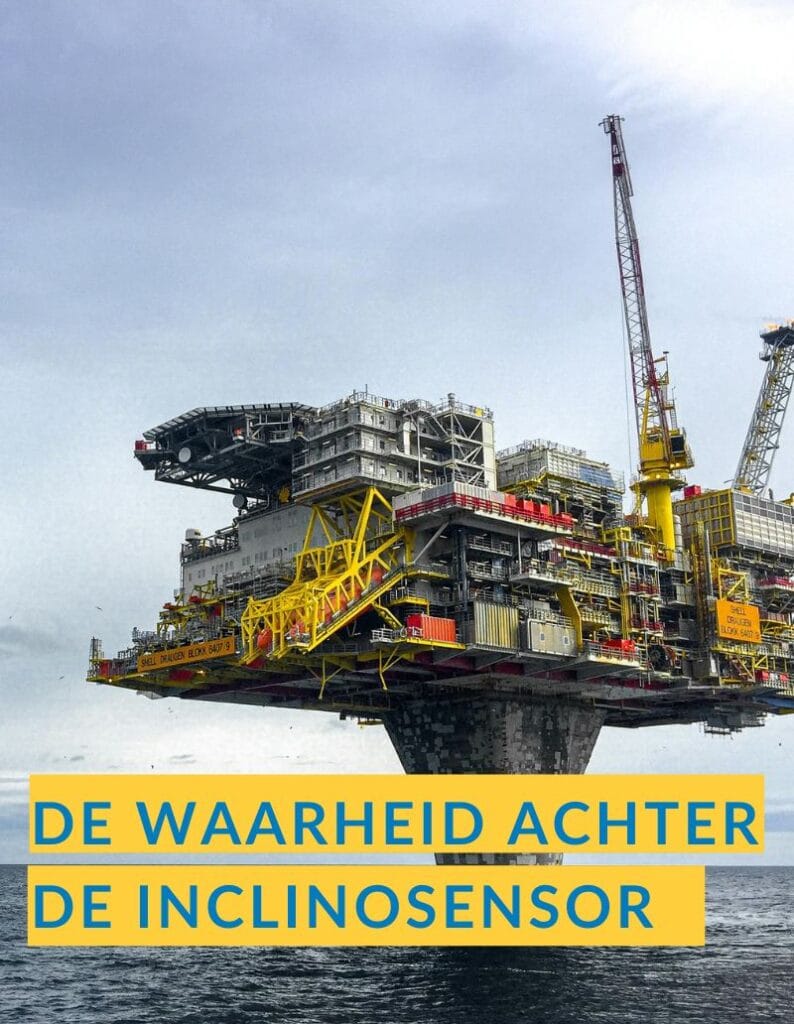
Inclination sensors are used to measure “tilt”. These highly reliable and accurate measuring elements are therefore frequently used to check whether certain structures are “straight”. This applies to both static buildings and mobile vehicles such as aerial work platforms or cranes, where human safety is also a factor. Anyone who understands how they work will also understand what the sensor can mean in many different sectors.

Forces that are aligned with gravity (perpendicular to the earth) cause few problems in practice in structures and (mobile) machines and equipment. However, if they deviate even slightly, or in other words, if they are crooked, they initiate torques and lead to loads that can be undesirable or even dangerous. In the past, master builders used a plumb line to determine whether their structures were straight. This was a purely mechanical solution consisting of a rope to which a weight was attached. This weight was pulled towards the earth by gravity, after which the rope indicated the perpendicular direction. This was the reference line used to check the perpendicularity of a building. At a later stage, a protractor was also added, which allowed any deviations to be accurately quantified.
Electronic spirit level: the inclination sensor
Nowadays, the mechanical plumb bob has been replaced by an electronic solution in the form of a so-called inclination sensor. This type of sensor works on the basis of a MEMS (Micro Electro Mechanical System) chip, made of silicon, and also measures the angle relative to the perpendicular to the earth. For this purpose, a mass is placed in the MEMS chip that can move between two or more fixed plates, as shown in the image below. Tilting the chip relative to the perpendicular line on the earth will cause the mass (orange) to shift between the fixed plates (green). This acceleration causes a change in the capacitive value between these surfaces, which can be converted into a voltage. The value of this voltage is then a measure of the angle that the sensor makes relative to the perpendicular line on the earth. In this way, the tilt of the sensor and thus the object to which it is attached can be determined.
Applications of the inclination sensor
Tilt sensors are logically used in applications where it is important to know whether there is any tilt and where the user wants to be able to monitor and control this tilt. For example, exceeding a certain value for objects, machines or vehicles can trigger a warning, an automatic correction or a standstill.
Examples
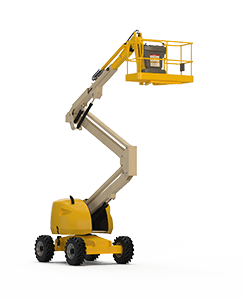
A good example of an application involves aerial work platforms where people are working at the top of the basket. Tilting is permitted up to a certain value, the limit being 5°, and exceeding this value can lead to dangerous situations. The combination of an inclination sensor, a PLC and the right programme makes it possible to monitor this limit. If it is exceeded, the PLC initiates an acoustic signal or stops the aerial work platform, for example. This control is becoming increasingly important in the context of legislation and regulations (including the Working Conditions Act). For example, strict requirements are imposed on the angle that mobile lifting and hoisting equipment makes at the installation site. By continuously monitoring this and storing the data if necessary, it can be demonstrated in the event of a possible calamity that this safety aspect was in order.
Another example concerns monitoring the tilt angle of (hoisting) cranes. Depending on the load, the boom may have a certain maximum tilt angle that can be easily monitored with an inclinometer. This is important to check, as exceeding this limit can cause the crane to tip over, an event that we have seen more often in the news in recent years. The sensors are also used in agricultural machinery, shipping (roll and pitch measurements), for levelling platforms, angle monitoring of multi-part booms such as concrete pumps, and weighing applications.
Advantages of an inclination sensor
An important advantage of an inclination sensor is its maximum reliability and high accuracy. This is because it relies on gravity, which is always present everywhere. In addition, it is a relatively simple sensor with no moving parts that can be used to monitor the tilt of an entire machine or structure. This means it can be used to ensure the safety of people (injury) and the environment (damage). The functional safety rating is up to SIL2/PLd.
Role of Rotero
Rotero offers a wide range of inclination sensors from DIS Sensors and has all the knowledge and experience needed to apply these components correctly. An accompanying range of accessories is also available to enhance and further improve the functionality of the inclinometers. You can also select the most suitable sensor for a specific application yourself via the product selector on the DIS Sensors website.