

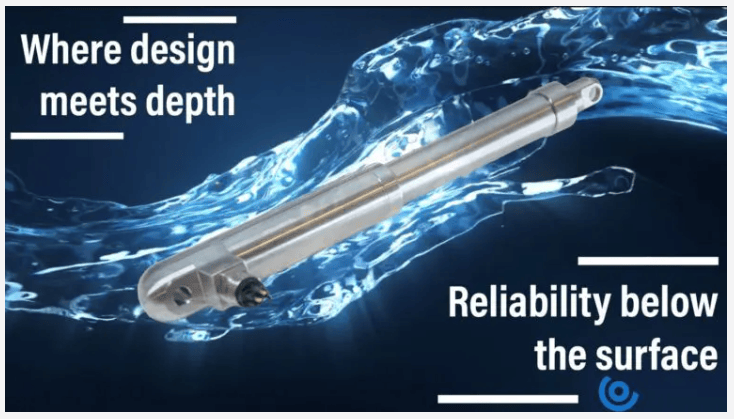
At a depth of 100 metres, conditions are significantly different from those above the water surface. The pressure is eleven times higher and accessibility for humans is extremely poor. When it comes to seawater, there is an additional risk of corrosion. Nevertheless, Concens’ UW100 series of underwater actuators are capable of functioning at these great depths. They are often used to make angle adjustments in combination with drilling platforms, submarines, cable layers and ROVs.
Electrical actuators in humid environments require the necessary measures to prevent malfunctions and corrosion. The requirements are even higher when these components have to perform their tasks underwater, let alone at a depth of 100 metres. At this depth, every square metre is subjected to a water column weighing 100,000 kilograms. Converted to pressure, this is 10 bar, to which the atmospheric pressure of 1 bar must be added. Total: 11 bar.
In terms of temperature, there are few peculiarities; in fact, temperatures are relatively constant deep underwater and range between 10 and 12 °C in Dutch waters. Of course, the situation is different when the application in question is located further north, where temperatures are close to freezing. These low temperatures can affect the materials used, which can become less strong or more brittle in cold conditions.
And there are more challenges. Such as the salty nature of seawater, which promotes corrosion. This is certainly the case when the wrong materials are chosen, as certain combinations can lead to galvanic corrosion. In addition, sand or other dirt in the same environment can have an abrasive effect on parts of the actuator. This is especially true when this dirt can become lodged between moving parts. Consider, for example, the seals that have the crucial task of keeping water out but are constantly subjected to varying loads from pressure, dirt and possibly temperature fluctuations.
Overcoming challenges
In short: there are plenty of challenges when asked to develop an underwater actuator for applications at a depth of 100 metres. This request came from a salmon farm in Norway that needed this solution to pull its nets into the correct position underwater.
Danish developer and manufacturer Concens took on this challenge, making good use of the wealth of knowledge and experience it has built up since its foundation in 2003. From the outset, the company has focused on developing compact, well-designed electric actuators for a wide range of applications. But there is more. In addition to technical know-how, Concens also values commitment, flexibility and versatility, enabling the team to develop the right solution for every problem. In addition, there is a focus on the design of the actuators, which are always sleek and smooth, making them ideal for medical, industrial and mobility applications.
Stainless steel and special gaskets
But back to Concens’ underwater actuators. In response to the salmon farmer’s request, the company introduced the UW-100 series, which includes four seawater-resistant models. All models have been developed for use at depths of up to 100 metres underwater. To this end, the actuators are completely waterproof and designed to the required strength.
The high strength has been achieved through the design itself in combination with the use of AISI316 stainless steel. The extra set of special gaskets helps to achieve the necessary watertightness at great depths for these IP69 underwater actuators. In addition, all underwater models are factory-fitted with a stainless steel Blueglobe cable gland and an integrated Hall sensor for position feedback. Depending on the transmission ratio, the actuators can generate high forces of up to 4500 N.
Performances
The first two models – the Con35 and the icon35 – are also known as the compact powerhouses. These models are available with a 24 VDC or a 12 VDC motor. In both cases, loads of 300 – 1900 N are achievable; with the heavier motor, higher speeds of up to 12 mm/s can be achieved.
The second set – the Con50 and the icon50 – are characterised by high forces and excellent efficiency. Here too, there is a choice of a 24 VDC or a 12 VDC motor with corresponding loads of 750–4500 N, depending on the transmission ratio. This allows speeds of up to 20 mm/s to be achieved for the larger motor and 14 mm/s for the 12 VDC version. The stroke length for all versions is a maximum of 400 mm.
Applications
The successful application of underwater actuators at the Norwegian salmon farm demonstrated that the UW100 series delivered the desired functionality at this great depth with a high degree of reliability. The latter is important because it is not desirable to have to regularly retrieve the actuators for maintenance.
This is every reason for Concens to further expand the series for various niche markets in Europe. Although not all applications take place at such great depths, the requirements are also strict at shallower locations, where high reliability is essential.
Intended applications include, for example, the movement of components in civil engineering structures. But applications are also conceivable on submarines or in the installation of drilling platforms and wind turbines on the seabed. They can also play a role in operating and moving research equipment (e.g. cameras) that is moved across the seabed by underwater robots or ROVs. For example, to check the condition of the seabed, take measurements in the context of deep-sea mining, check infrastructure on the seabed or collect data in the context of climate change. In addition, these types of actuators are ideally suited for operating valves in pipelines located at greater depths.
Would you like to know more about Concens’ UW100 series underwater actuators? Please contact Rotero.