

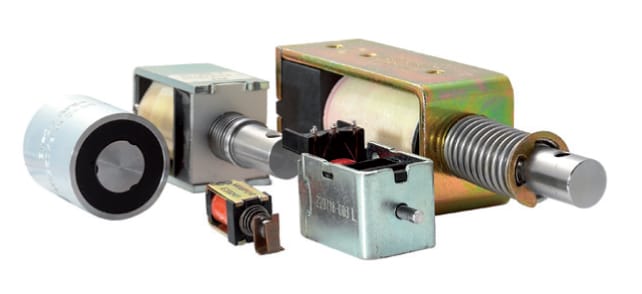
Magnetic locking mechanisms can be divided into three categories. These are distinguished by the way in which the mechanisms are operated, the amount of energy required to do so, and the unlocking force that can be generated by the spring mechanism. The three categories will be discussed in the coming weeks. This week, part 2:
Magnetic locking mechanism
A magnetic latching mechanism or MLM (Magnetic Latching Mechanism) can exert extremely high counter forces in a much smaller housing than is possible with an MLS.
Magnetic locking mechanisms use the stored energy of the counter spring to achieve high impact and linear movement. This is possible by applying only a very small electrical energy pulse to activate the counter spring.

Figure 1: Magnetic locking mechanism (MLM) in the tensioned position
Unlike an MLS, which can position the housing completely independently, the high impact force combined with the compact dimensions of the MLM require the housing to be manually brought into the so-called “tensioned” state. In this state, the counter spring will be fully compressed, with the permanent magnet holding the housing in this position; the energy in the tensioned spring is retained until it is needed.
Although the MLM coil is far too small to bring the housing into the tensioned position on its own, only a small amount of energy is needed to release it again. This is because the small electrical pulse generates a magnetic field in the relatively small coil of the MLM that is large enough to cancel out the holding force of the permanent magnet. When this happens, the spring-loaded element is activated.
Once the MLM has been manually tensioned, it can remain in this position indefinitely until a situation arises in which the release mechanism must be activated.
The source of the small electrical pulse required to interrupt the holding force of the permanent magnet can be a battery or even a capacitive discharge circuit.
Typical MLM applications
- Fire protection system actuators
- Power interruption locking mechanisms
Key advantages of MLM
- Extremely high counter forces, capable of generating high impact forces
- Compact dimensions (compared to an MLS)
- Extremely low requirements with regard to operating current
Author: David Stockwell of Magnet Schultz
Read also: