

Magnetic locking mechanisms can be divided into three categories. These are distinguished by the way in which the mechanisms are operated, the amount of energy required to do so, and the unlocking force that can be generated by the spring mechanism. The three categories will be discussed in the coming weeks. This week, we will look at the first category:
Permanent magnet / electromagnetic linear actuator
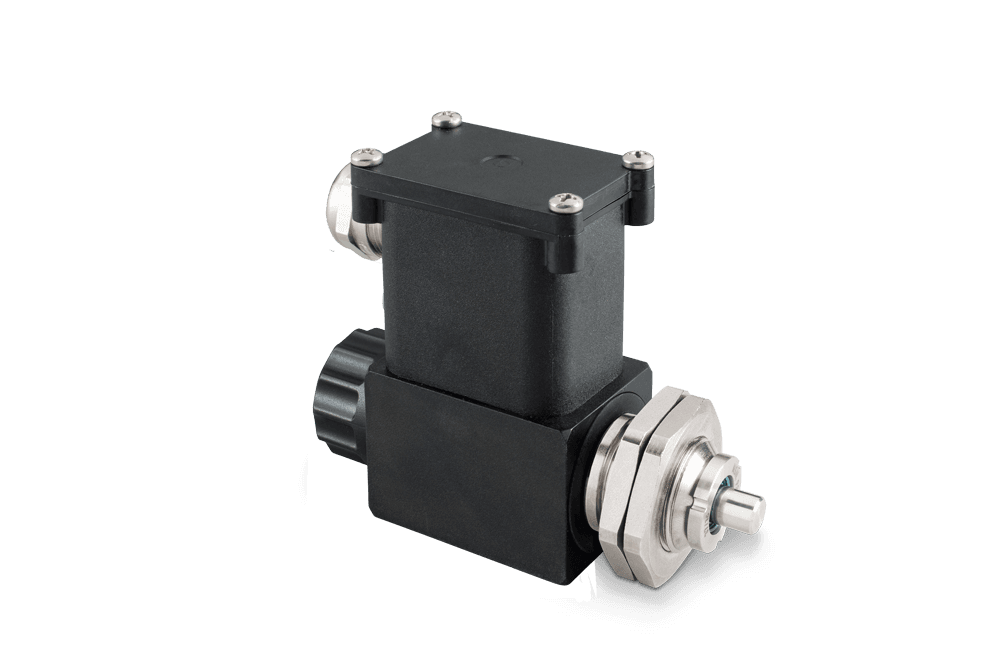
The permanent magnet or electromagnetic linear actuator is also known as a magnetic latching solenoid or MLS. The design of an MLS is such that the solenoid coil only needs a short current pulse to overcome the force of the return spring system (in Figure 1, this is a spring). This energy pulse moves the solenoid housing from the “deactivated” to the “activated” position (in Figure 1, the solenoid is activated).

Figure 1: Magnetic locking solenoid shown in the “engaged” state.
Once in the engaged position, the permanent magnet in the MLS will hold the fixture in place, preventing it from springing back to the disengaged position.
When necessary or desired, the fixture can be unlocked to the “off” position by sending a small pulse of electrical energy through the solenoid coil with a polarity opposite to that of the permanent magnet. The pulse of this reverse magnetic energy is sufficient to largely cancel out the holding force of the permanent magnet on the armature, allowing the return mechanism (the spring) to easily return the armature to its original position.
The physical dimensions (the dimensions of the coil, the permanent magnet and the solenoid housing) of an MLS are entirely dependent on the desired release force. The greater this force, the larger all other components must be in order to achieve it. This also applies to the amount of electrical energy that must be supplied to the coil to switch it on and off.
Typical MLS applications
- medical cabinets, cabinet locking
- circuit breakers
- locking mechanisms for solar power stations
- locking of chargers for electric vehicles
- door locks
Advantages of MLS technology
One of the most important advantages of MLS technology is energy saving. After all, an MLS can remain continuously in the “off” or “on” position without requiring any energy. Energy is only required for the actual switching operation. This type of energy saving is particularly valuable in battery-powered applications or other situations where minimal energy consumption is important.
Author: David Stockwell of Magnet Schultz
Read also: