

Roberto van den Kieboom has spent his entire career in the recycling industry, where he gained a wealth of knowledge and experience. However, nowhere did he see his ideas for separating scrap iron realised as well as in his own mind. So in 2014, he started his own company – TA-PO – and built his own machine that can separate electronic scrap into magnetic and partially magnetic fractions based on magnetism. For easy maintenance, he used Rotero’s Concens actuators, among other things.

Why make things difficult when… Concens actuators can support a smart design
When processing electronic scrap, the iron is first separated using large magnets. The residual stream often still contains a relatively large amount of copper, which is removed manually, mainly in the form of motor anchors and transformers. However, this residual stream contains much more material that is suitable for reuse, but it is not easily recognisable or is too small for people to see, and is therefore not removed by the “pickers”.
For this reason, Robert van den Kieboom developed a machine that separates scrap based on magnetism into a stream of “magnetic material” and a stream of “less magnetic material”. ‘Ultimately, this machine yields a return of 25% of the input when processing electronic scrap. Compared to hand picking, where the return is around 8%, this is a huge improvement. In addition, the second compartment in the machine, where most of the magnetic material is collected, contains a high copper content, which therefore yields more.’
Maintenance requirements
But Roberto van den Kieboom did not focus solely on the functionality of the machine: “Experience shows that when developing many machines for recycling, little consideration is given to the maintenance required, which translates into, among other things, difficult replacement of the conveyor belt. It often takes at least half a day to dismantle the covers, replace the belt and reassemble the covers. The long time required for this is partly due to the fact that the covers are heavy, large – up to 5 m – and awkward to handle. Because it is not permitted to use a belt with a zip fastener in these machines (it must be endless), I came up with a different solution.
Automatically controlled hoods
Identifying the problem is often half the solution, so Van den Kieboom developed side covers for his machine that can be opened automatically and remotely. After this, the conveyor belts can be replaced within 20 minutes. The replacement process consists of placing the chute on the side, automatically opening the covers and finally removing the lightweight aluminium covers and beams. The conveyor belt is then completely free and can be replaced by removing it with a forklift and installing a new one. The machine provides all the space the forklift needs to access it properly.
To open and close the covers, Robert van den Kieboom’s engineer – who developed the solution and drew it in a CAD programme – searched the Internet and came across Rotero. Van den Kieboom: ‘One of their specialists first visited us at our invitation to discuss the idea, after which we decided on the Concens actuators. These inline actuators were first engineered to length, then ordered and finally mounted with just two bolts. After fine-tuning them via the accompanying control system, the machine was ready for use.’
High quality with the right look and feel
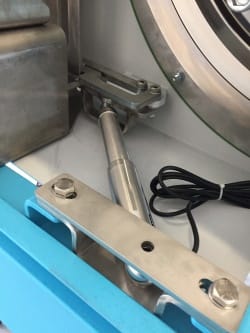
The choice of Concens actuators was no coincidence. Among other things, the owner of TA-PO was impressed by the appearance of the product, which is characterised by its modern, compact design and integration of components. In addition, they are made of 100% stainless steel, which is very important in relation to the operation of the magnet. Furthermore, the components offer the required service life and the actuators can be easily configured using the accompanying control system. Van den Kieboom: “This allows me to define a minimum and maximum level in the software and to adjust this at any time without actually having to make changes to the machine.
So yes: I am very happy with Rotero’s products, but also with the advice we received during the development phase. We had quite a few questions, all of which were answered satisfactorily and helped us to realise this part of the machine – simple maintenance – entirely according to our wishes. Before readers ask the question: yes, this solution makes the machine more expensive, but first calculate what half a day of downtime costs compared to 20 minutes, and you will realise that you are making a more than responsible decision.
References
The machine has now been delivered to two customers, where it is operating to their complete satisfaction, and preparations are being made in the workshop for a new order.
Want to know more?
Would you like to know more about these actuators or do you have an application for which you are still looking for a solution? Please contact us! We will be happy to help you!
________________
Concens linear inline actuator
The Danish brand Concens has been distributed by Rotero for quite some time, both in the Netherlands and Belgium. The company designs, develops and manufactures linear inline actuators that, in keeping with Scandinavian tradition, are characterised by their sleek, modern and compact design. These actuators are individually tested and made from high-quality materials. This, in combination with the standard IP66 protection class (optional IP68 and IP69K), means that the actuators can be used both indoors and outdoors. The temperature may vary between -5° and 70 °C. They are an attractive alternative to linear lifting, pulling, pushing and lifting movements up to 10,000 N in industry, which are driven hydraulically or by compressed air. They are also suitable for maritime applications and use in various machines for the food industry.