

Industrial robots are uniquely suited to improve the efficiency of production and logistics. One disadvantage, however, is that some companies simply don’t have the financial resources to utilise robots, while others lack the required programming knowledge. To eliminate that last hurdle, Oriental Motor has developed the MRC01 controller for operating robots with no prior knowledge of programming.
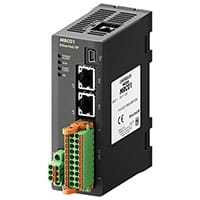
For many companies, programming is a skill they do not directly master. But with the MRC01, Rotero offers a solution from Oriental Motor that even inexperienced operators can use to create a functional programme for industrial robots in just one hour.
The controller has been specially designed for applications which are powered by motors from Oriental Motor’s AZ series. This series contains closed-loop stepper motors that, among other uses, are suited for absolute positioning (without a battery). Using them to power robot applications is thus an obvious choice.
The ease of operation lies in the control that automatically takes care of the complex kinematic calculations. This includes teaching the Tool Center Point (TCP), a point that forms the foundation for the rest of the programming. After learning the TCP, the robot can move back to the same position from various angles.

The user can then opt to use a Cartesian coordinate system, a manual flange coordinate system, an equipment coordinate system, or an axis coordinate system. The controller also offers the option of a programming mode, a direct data mode, and the JOG/inching/ZHOME mode. Because possible axis offsets are considered in the programming, the MRC01 is even suitable for robots with a large number of degrees of freedom.
What’s more, the MRC01 supports EtherNet/IP, which enables movement sequences for internal robots. This is done by transferring movement block data to a controller at a higher level.
Finally, the MRC01 has eight inputs and eight outputs for direct I/O functions. This enables the easy performance of various control tasks, such as the start/stop operation and controlling peripheral equipment. Several security functions reduce the risk of unintended movements. For example, the controller blocks the operation of the robot when it makes an unexpected or dangerous movement while learning.