

Choosing the right solenoid is not always easy. There are so many options and possibilities available that the well-known proverb about the trees and the forest applies here. In addition, manually comparing all specifications and graphs is a time-consuming task that not everyone is keen to do.
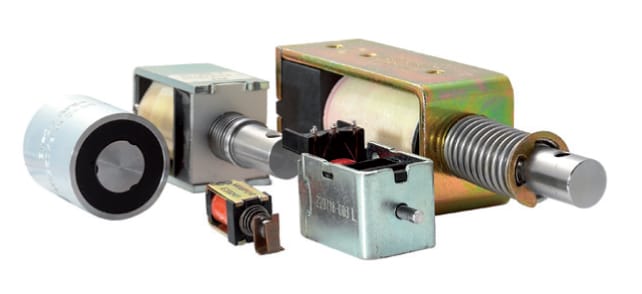
Of course, you can send us your specifications and requirements so that we can make the right choice for you. However, many customers want to be able to make an independent pre-selection themselves and would benefit from a guide that leads them step by step to the right solution. Magnet Schultz has written the following short guide especially for this group, which reduces the number of possible solutions to a manageable amount in just a few steps.
The Magnet Schultz design catalogue offers the option of sorting different versions by entering the various properties of the desired solenoid in the drop-down selection boxes. This is also possible in every online or printed design/product catalogue.
Start based on properties
In order to select the correct solenoid, the following five characteristics of the component are initially considered:
- Function
- Stroke length and force
- Operating time
- Dimensions
- Tension
First, it is determined which of the above five variables are already specified by the application. After all, the more parameters that are specified in advance, the faster the correct selection can be made. If the value of a particular characteristic falls outside the standard options, it is skipped for convenience. By filling in the remaining points, the designer will ultimately arrive at the product that most closely resembles the final solution. This product is then a logical starting point for adaptation to the desired solenoid.
- Function
When filling in the properties, the first thing to consider is the “function”. Is it a tension or compression application? Answering this question roughly halves the number of options. If an additional spring return is required, it is still possible to choose between pull or push. In that case, however, it is important that the spring’s push-back force is included in the requirements for maximum force in the next step.
- Stroke length and power
Because stroke length and force are inextricably linked, these two variables are dealt with in a single step. In the Magnet Schultz catalogue, the force/stroke search option can be used at the top of the page. For anyone using a printed or other type of catalogue – where it is not possible to sort by force – it is more convenient to skip this step until the end of the elimination process.
Manually comparing the power curve using graphs is the most time-consuming part of the selection process. When a manual comparison is necessary, it is best to save this step until the number of options has been reduced to a minimum.
- Operating time
Continuous, intermittent (periodic) or pulsed? Select the on/off cycle that suits your application. If you are unsure, you can read the blog (in English) for a general explanation of the concept.
During this and the next step, it may happen that all options are suddenly crossed out and there does not seem to be a suitable solenoid for your application. In most cases, this means that the values entered for force or stroke length are disproportionate to the size of the solenoid you are looking for. This problem can be solved by either focusing on a customer-specific design or reassessing the application and seeing if the goal can be achieved in another way.
- Dimensions
Remove all components that are too large for the application.
- Excitement
The voltage is only selected at the end because this is the value that is easiest to adjust. 12, 24 and 120 VDC are the most commonly used voltages, and adjusting the winding for a customer-specific product is often cheaper and easier than adjusting the armature or frame.
Other considerations
Customer-specific anchors and frames, protection against dirt ingress, different types of connectors, pull/push functionality, locking/securing, and spring returns: all features that belong to a solenoid that has been specially adapted to an MSA design. These are therefore not to be found in the standard catalogue.
But once again: go through this selection procedure and determine the best “lookalike” in this way. In most cases, this is the best starting point for requesting the design or modification process from Rotero.
Questions? We are here to help! You can reach us by telephone on 0348 – 495 150 (NL) and 015 451 840 (BE). Of course, you can also send us an email.