

As the exclusive representative of Magnet-Schultz in the Benelux, Rotero not only offers an extensive and impressive standard range of solenoid products, but also the possibility to develop customer-specific products. Both solenoids and actuators. The starting point is often a standard product that is adapted to the customer’s requirements.
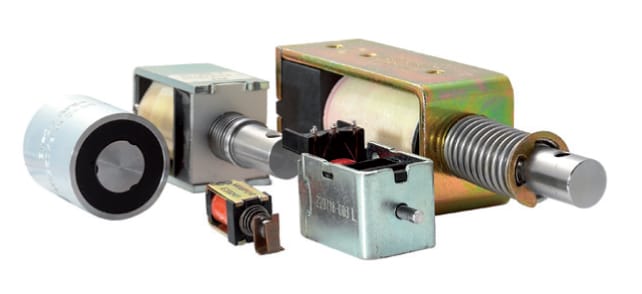
Magnet Schultz engineers are in daily contact with developers or purchasers regarding specific functionality or performance requirements for a desired solenoid product. In many cases, a solution can be found in the standard range, but this is not always possible. For these specific cases, Magnet Schultz specialists can modify an existing product, thereby adding value. But what are the possibilities?
Return ticket
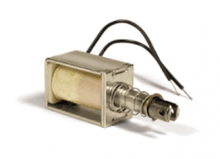
In a solenoid without a spring return, the plunger must be returned to its starting position by gravity or a specific mechanism in the application. By adding a spring, the plunger is able to return to its original position independently. A spring is usually fitted around the open end of the plunger. A groove is then machined into which a ring is placed. This gives the spring a surface to push against. Depending on the application, it is also possible to integrate the spring internally.
Coil winding

The density and number of copper windings in a solenoid coil determine the voltage and duty cycle. An oversized coil will create magnetic inefficiencies and waste power (and money), while an undersized coil can generate heat and cause problems with the duty cycle. When the customer requires a non-standard voltage, Magnet Schultz is able to produce a custom coil that suits the specific application.
Secured plunger

Applications that do not limit the stroke length of the solenoid may encounter situations in which the plunger easily becomes detached. Like many other manufacturers, Magnet Schultz does not use secured plungers in standard products. Securing a plunger without knowing the end user’s stroke length limits the number of applications. However, if the exact stroke length is known, Magnet Schultz can secure the plunger by adding a push rod with a groove and an O-ring at the correct distance.
Connector type
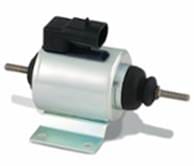
Power wires or cable lugs are industrial standards, but there is a wide choice of possible connectors. Magnet Schultz offers the option of integrating the desired connector directly into the moulded housing of the solenoid or at the end of the cable. Integration of the desired connector can contribute to easy installation by eliminating soldering work.
Shape of the plunger
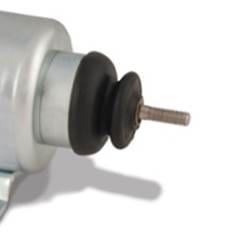
Changes to the plunger ends are relatively common in order to simplify the integration of the solenoid into a larger application. Magnet Schultz reference products have special ends for both pull and push applications, while customer-specific products can be fitted with a threaded end, a tapped end or left completely blank. The internal end of the plunger can also be machined to create different shape profiles that influence the stroke characteristics.
Casting and encapsulation
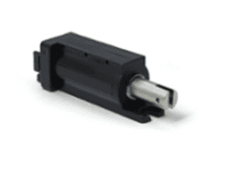
For solenoids that may come into contact with water or oil, or variants that must function under other harsh environmental conditions, it is possible to encapsulate the coil or encase the entire unit, depending on the desired protection against the ingress of contamination. The type of connector can also influence the resistance of solenoids to these elements.
Locking
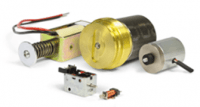
A lock on one or both sides of the solenoid is possible. This lock is achieved by integrating a permanent magnet at the end of the unit where the plunger needs to be locked. The electromagnetic flux of the solenoid can be used to neutralise the pulling force of the permanent magnet and thus unlock the plunger.
Bi-directional operation
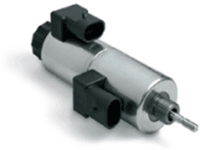
Finally, bidirectional operation can be achieved by using two coils that influence the same plunger. The plunger is positioned in such a way that each coil – when energised – pushes the plunger away from a central point. Although the addition of a second coil increases the cost of the unit, in applications where a spring return is not sufficient, a bi-directional solenoid can be a unique and suitable solution.
If you would like to know more about customer-specific, customised solenoids, please contact Rotero.